
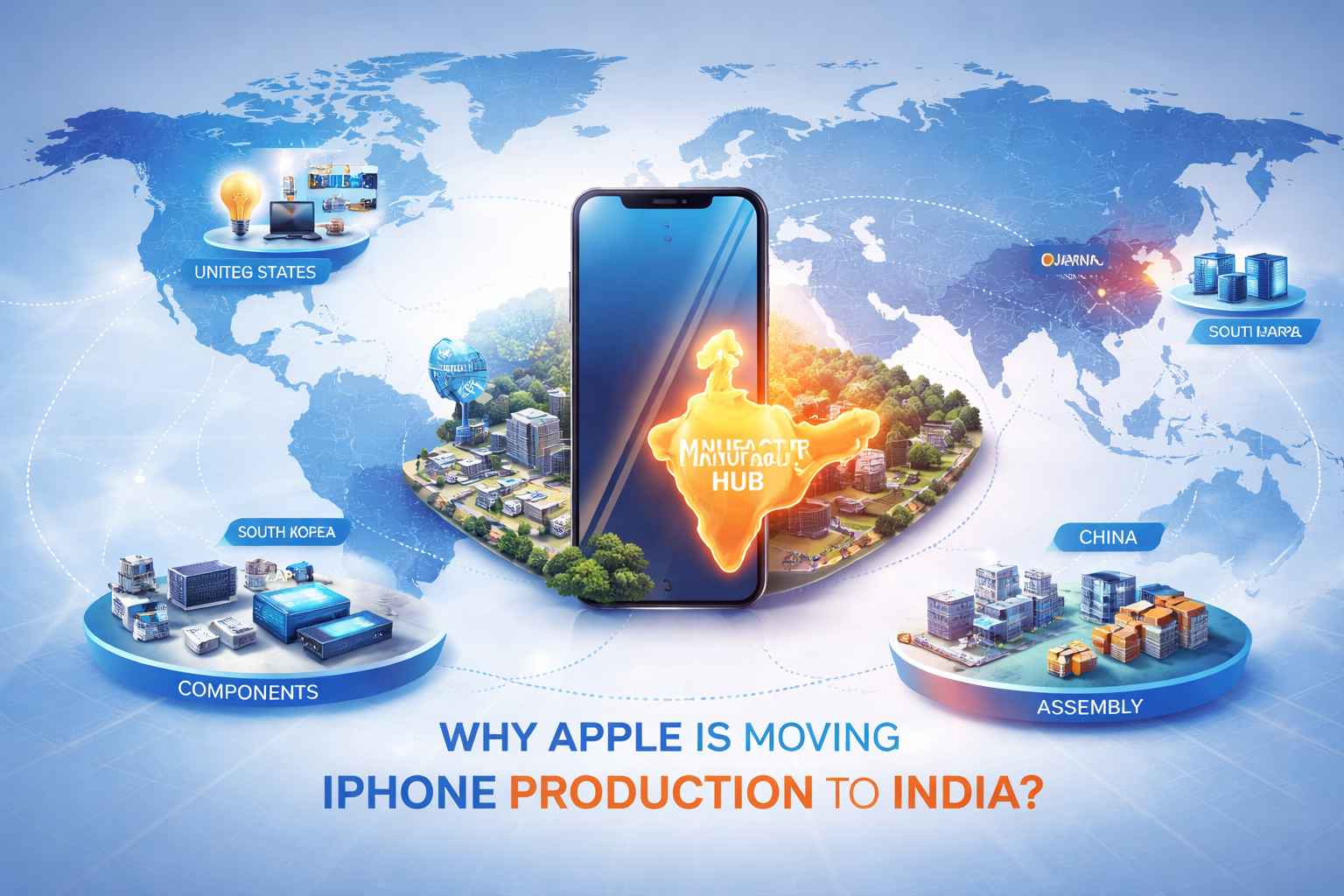
Why Is Apple Inc. Moving iPhone Production to India? (Explained with Global Supply Chain Concepts)
Introduction
In today’s interconnected world, products are rarely made in a single country. Instead, they are created through a complex network of global operations known as supply chains. One of the most powerful examples of this system is the iPhone, designed and marketed by Apple Inc..
For years, Apple relied heavily on China for assembling iPhones. However, the company is now rapidly expanding its manufacturing footprint in India.
This shift is not random—it reflects major global trends in business, economics, and politics. So, why is Apple moving iPhone production to India? To answer this, we need to understand how global supply chains work and why companies diversify manufacturing.
What Is a Global Supply Chain?
A global supply chain is the entire process through which a product is designed, manufactured, and delivered across multiple countries.
How It Works (iPhone Example):
- Design and innovation: United States
- Components: Japan, South Korea, Taiwan
- Assembly: China and increasingly India
This system allows companies to reduce costs, access specialized skills, and increase efficiency. In simple terms, no single country does everything—each plays a role.
What Is the China+1 Strategy?
The China+1 strategy is a business approach where companies keep operations in China but also expand to another country.
Why Is It Important?
- Reduces risk of disruption
- Avoids over-dependence on one location
- Improves flexibility in production
For Apple Inc., India is becoming the “+1” alternative to China.
Why Do Companies Shift Manufacturing?
To understand Apple’s decision, it is important to look at broader business reasons.
Cost Optimization
Companies look for long-term cost advantages, including labor, logistics, and taxes.
Geopolitical Factors
Global tensions between major economies can affect trade and production.
Supply Chain Risks
Events like COVID-19 revealed how fragile global production systems can be when concentrated in one country.
Future Growth Strategy
Businesses plan years ahead. Diversifying manufacturing locations ensures long-term stability.
Case Study: Why Apple Is Moving Production to India
Now let’s connect theory to reality.
Reducing Dependency on China
Apple is reducing its reliance on China by expanding production in India.
Managing Trade Barriers
Producing locally in India helps Apple avoid import duties and makes its products more competitive in the local market.
Strengthening Supply Chain Resilience
Multiple manufacturing locations allow Apple to continue production even if one region faces disruption.
Expanding in a High-Growth Market
India is one of the fastest-growing smartphone markets, making it both a production base and a major consumer market.
Why India Is Becoming a Manufacturing Hub
India is emerging as a strong global manufacturing destination for several reasons:
Government Support
Policies like the Production-Linked Incentive (PLI) scheme encourage companies to manufacture locally.
Workforce Advantage
India offers a large labor pool with improving technical skills.
Infrastructure Development
The country is investing in transportation, logistics, and industrial development.
Market Potential
With a growing middle class and increasing smartphone demand, India is an attractive market for global brands.
Key Terms Explained
Supply Chain
A network of processes involved in producing and delivering a product.
Tariffs
Taxes on imported goods that can increase product prices.
Manufacturing Hub
A region known for large-scale production activities.
Diversification
Spreading operations across different locations to reduce risk.
Impact on India and the World
Economic Impact on India
- Job creation
- Increased exports
- Growth in manufacturing sector
Impact on Apple
- Reduced operational risks
- Better flexibility
- Stronger global presence
Impact on Consumers
- Improved product availability
- Possible long-term price stability
- Faster delivery in local markets
Future Outlook
When Will Apple Expand Further?
Apple is expected to significantly increase its production in India over the next few years.
Can India Replace China?
Not immediately. China still leads in infrastructure and supply chain maturity, but India is rapidly catching up.
Key Challenges
- Infrastructure gaps
- Higher initial costs
- Skill development at scale
Quick Summary
- Apple is moving production to reduce dependency on China
- India is part of the China+1 strategy
- Global supply chains require multiple locations
- India offers growth, incentives, and market demand
- This is a long-term strategic move, not just cost-cutting
Frequently Asked Questions (FAQs)
Why is Apple moving iPhone production to India?
Apple is shifting production to India to diversify its supply chain, reduce reliance on China, and take advantage of government incentives and market growth.
Why is Apple moving production away from China?
Due to geopolitical tensions, rising costs, and risks highlighted during the COVID-19 pandemic, Apple is reducing its dependence on China.
What is the China+1 strategy?
It is a strategy where companies expand manufacturing beyond China to reduce risks and improve flexibility.
When did Apple start manufacturing in India?
Apple began assembling iPhones in India around 2017 and has been expanding its operations since then.
Will iPhones become cheaper in India?
Prices may become more competitive over time due to reduced import duties, but major price drops are unlikely in the short term.
How many iPhones are made in India?
India currently produces around 20–25% of global iPhones, and this share is expected to grow.
Can India become Apple’s main manufacturing hub?
India has strong potential, but China will likely remain a major hub in the near future.
Conclusion
The decision by Apple Inc. to expand iPhone production in India reflects a broader transformation in global manufacturing. Companies are no longer relying on a single country; instead, they are building flexible, diversified supply chains.
For India, this shift represents a major opportunity to strengthen its position in the global economy. For consumers, it ensures better stability and availability of products.
As global trends continue to evolve, strategies like these will play a crucial role in shaping the future of technology and international trade.