What Are the Seven Phases of the Impulse Purchase Cycle? (Complete Guide)
Introduction
Did you know that a large percentage of purchases—especially online—are made on impulse? Studies from sources like Statista show that impulse buying plays a major role in consumer behavior worldwide.
Whether it’s a flash sale, a “limited stock” alert, or a personalized recommendation, consumers often make quick, emotion-driven decisions.
In simple terms:
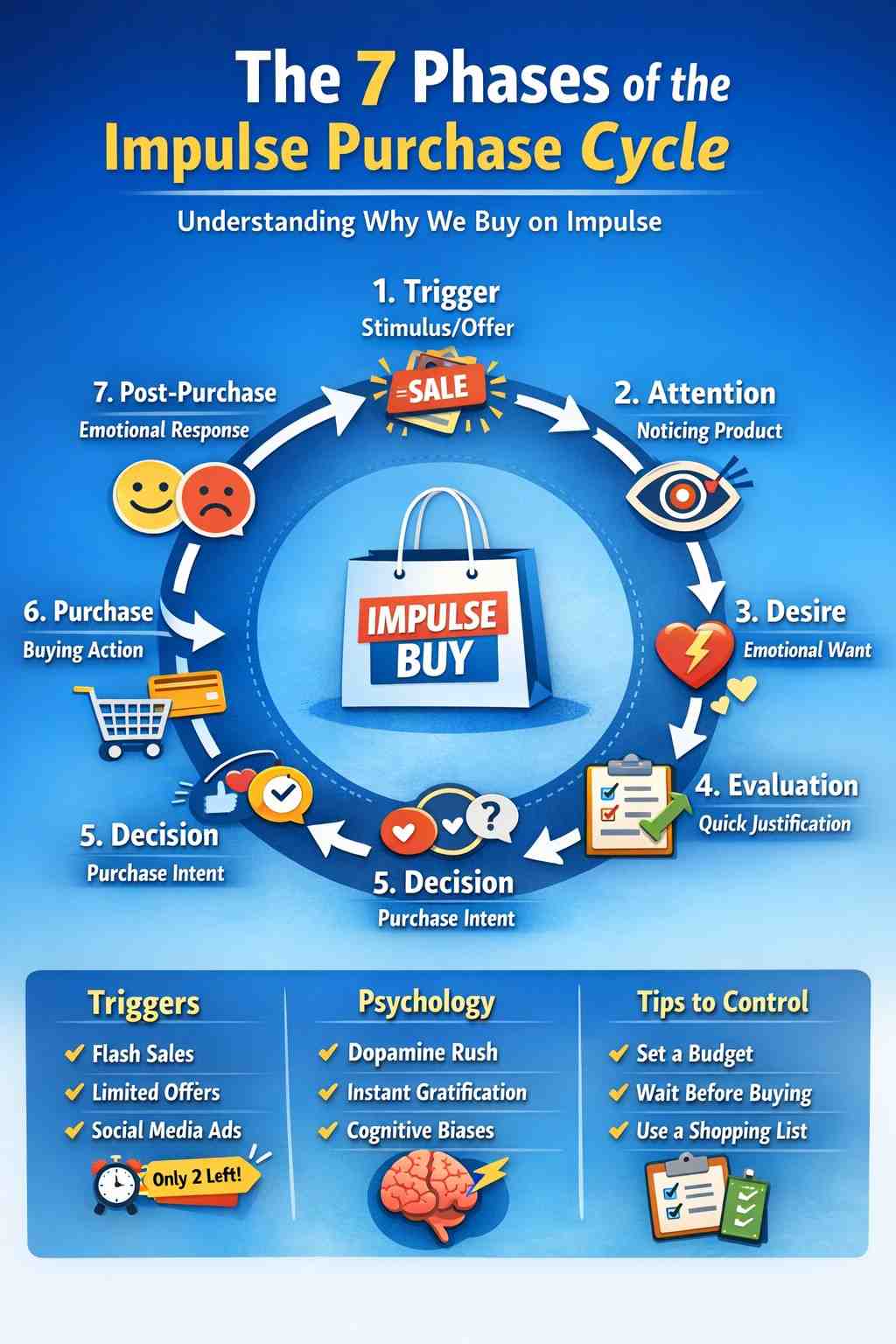
The impulse purchase cycle consists of seven stages—trigger, attention, desire, evaluation, decision, purchase, and post-purchase reaction.
In this guide, you’ll learn how each phase works, the psychology behind it, and how businesses use it to increase sales.
What Is Impulse Buying?
Impulse buying is a spontaneous, unplanned purchase decision driven primarily by emotions rather than logic.
Unlike planned purchases, it happens quickly, often without comparing alternatives or considering long-term value.
Example:
You visit Amazon just to browse—and end up buying something within minutes.
Key Takeaways (Quick Answer for AI Overview)
- The impulse purchase cycle has 7 stages
- Emotional triggers drive most impulse purchases
- Consumers rely on mental shortcuts and biases
- Brands use urgency, scarcity, and design to influence decisions
- Awareness can help control impulse buying
The 7 Phases of the Impulse Purchase Cycle
| Phase | Description |
|---|---|
| Trigger | A stimulus sparks interest |
| Attention | The product grabs focus |
| Desire | Emotional urge develops |
| Evaluation | Quick mental justification |
| Decision | Intent to buy is formed |
| Purchase | Transaction is completed |
| Post-Purchase | Emotional response after buying |
Phase 1 – Trigger (The Starting Point of Impulse Buying)
Every impulse purchase begins with a trigger. This could be external (ads, discounts) or internal (mood, boredom, stress).
Common Triggers
- Flash sales and limited-time offers
- Social media ads
- Influencer promotions
- Emotional states like stress or excitement
Psychological Insight
Impulse buying is linked to the brain’s reward system. When consumers encounter attractive deals, the Dopamine Reward System is activated, creating excitement and urgency.
Brands amplify this using:
- Scarcity (“Only 2 left!”)
- Urgency (“Offer ends tonight!”)
Phase 2 – Attention (Capturing Consumer Focus)
Once triggered, the next step is grabbing attention. If the product fails here, the cycle stops.
What Captures Attention
- Bold discounts and visuals
- High-quality product images
- Clean UI/UX design
- Scroll-stopping social media ads
Marketing Insight
Brands design interfaces to keep users engaged and visually stimulated, increasing the chances of moving to the next stage.
Phase 3 – Desire (Where Impulse Buying Peaks)
This is the most critical stage—where the consumer begins to want the product.
At this point:
- Emotions override logic
- The product feels personally relevant
- Urgency increases
Why Desire Builds Quickly
Impulse buying is influenced by:
- Instant Gratification
- Behavioral Economics
Consumers prioritize immediate pleasure over long-term benefits.
Phase 4 – Evaluation (Quick Justification Stage)
Even in impulse buying, the brain briefly tries to justify the purchase.
Common Thoughts
- “It’s a great deal”
- “I might need this later”
- “I deserve it”
Cognitive Biases Involved
- Cognitive Bias
- Anchoring effect (comparing original vs discounted price)
This stage is fast and often irrational.
Phase 5 – Decision (The Buy Moment)
Here, the consumer decides to purchase—usually within seconds.
Key Influencers
- Limited-time pressure
- Easy checkout process
- Emotional excitement
Role of Mental Shortcuts
Consumers rely on:
Examples include:
- “Best seller” labels
- High ratings and reviews
Phase 6 – Purchase (Transaction Stage)
This is where the transaction is completed.
What Makes This Stage Powerful
- One-click checkout
- Saved payment methods
- UPI and mobile payments
Reducing friction significantly increases conversions.
Phase 7 – Post-Purchase Behavior
After buying, consumers experience emotional reactions.
Possible Outcomes
- Satisfaction (“Great deal!”)
- Regret (“Did I need this?”)
- Excitement (waiting for delivery)
This phase influences future buying behavior and brand loyalty.
Real-Life Case Study: How Amazon Drives Impulse Buying
Amazon is one of the best examples of the impulse purchase cycle in action.
Strategies Used
- “Buy Now” button reduces decision time
- “Only X left in stock” creates urgency
- Personalized recommendations trigger desire
- Lightning deals push immediate action
These tactics align perfectly with each stage of the impulse purchase cycle.
What Triggers Impulse Buying?
Several factors increase the likelihood of impulse purchases:
- Discounts and price cuts
- Limited-time offers
- Social proof (reviews, ratings)
- Emotional states (stress, boredom)
- Personalized product suggestions
Research highlighted by Harvard Business Review shows that emotional triggers play a major role in purchase decisions.
How Businesses Use the Impulse Purchase Cycle
Brands strategically design their marketing to influence each stage.
Common Techniques
- Countdown timers
- Flash sales
- Product recommendations
- Strategic product placement
- Frictionless checkout systems
These methods increase both engagement and conversions.
Pros and Cons of Impulse Buying
Pros
- Instant satisfaction
- Discovering new products
- Emotional excitement
Cons
- Overspending
- Buyer’s remorse
- Poor financial planning
How to Control Impulse Buying
If you want to make smarter financial decisions:
- Follow the 24-hour rule before purchasing
- Set a clear budget
- Avoid shopping when emotional
- Unsubscribe from marketing emails
- Stick to a shopping list
Awareness is the first step toward control.
FAQs
What are the seven phases of impulse buying?
The seven phases are trigger, attention, desire, evaluation, decision, purchase, and post-purchase reaction.
Why do people make impulse purchases?
Impulse purchases are driven by emotions, psychological triggers, and the desire for instant gratification.
Is impulse buying good or bad?
It can be beneficial for quick satisfaction but often leads to overspending and regret.
How can I stop impulse buying?
You can control it by setting budgets, delaying decisions, and recognizing marketing triggers.
Conclusion
The impulse purchase cycle shows how quickly emotions can influence buying decisions. From the initial trigger to post-purchase feelings, each phase plays a crucial role in shaping consumer behavior.
For businesses, understanding this cycle means higher conversions. For consumers, it means better control over spending.